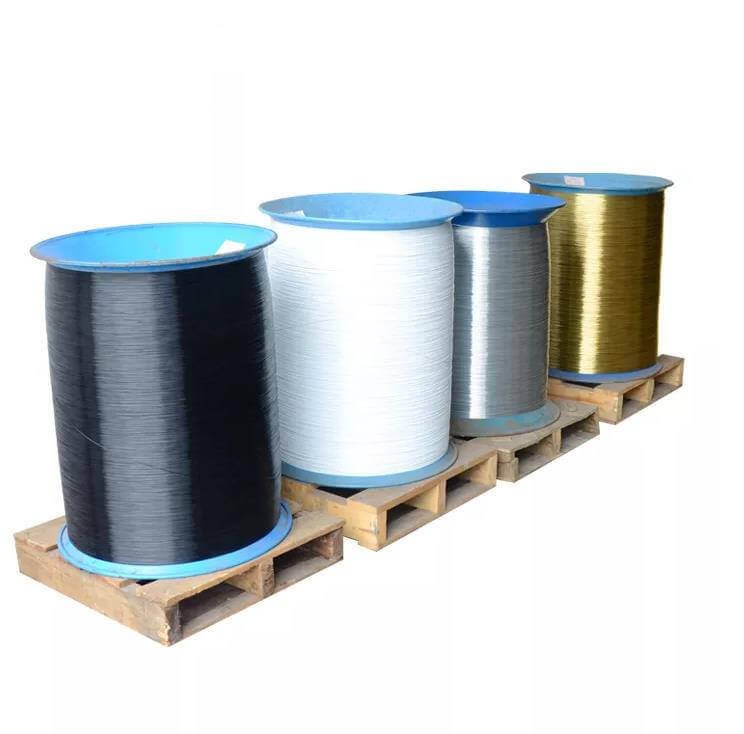
Custom Mechanical Performance for Nylon Coated Wire
In the mass production of stationery, the mechanical properties of nylon-coated wire directly determine forming stability, user experience, and product consistency. Our mechanical property customization capability focuses not on pursuing extreme values, but on establishing a performance range that is “stable, reproducible, and suitable for mass production” for various stationery applications.
Why Customized Mechanical Properties Are Critical for Mass Production?
In actual production and use, improper control of mechanical properties typically leads to the following risks:

Inconsistent elasticity during forming causes unstable ring diameter or clamping force

Excessive or insufficient rebound affecting binding tightness or clamping effectiveness

Coating cracking or peeling during bending

Noticeable variations in user experience across different production batches
Therefore, truly effective mechanical property customization must simultaneously address material structure, coating influence, and molding process compatibility.
Our customizable key mechanical performance metrics
Tensile Strength
Customize appropriate strength ranges for different stationery applications
- Avoid excessive strength causing forming difficulties
- Prevent insufficient strength from compromising structural stability
Application-oriented:
- Twin ring wire: Emphasizes structural stability after forming
- Spiral binding wire: Balances flexibility and durability
Elasticity & Spring-back
- Control spring-back amplitude to ensure consistent formed dimensions
- Prevent uneven tightness in finished products due to spring-back variations
- Supports high-speed, continuous forming equipment
This is one of the key indicators affecting stationery product consistency.
Formability
- Optimizes bending performance to reduce wire breakage and surface damage
- Ensures stability during repeated bending or complex forming processes
- Improves production yield while reducing scrap rates
Fatigue Resistance
- Enhances durability under repeated opening/closing or stress cycles
- Extends the service life of stationery products
- Reduces failure risks during end-use
- Particularly critical for spiral binding and paperclip products.
Coating Adhesion and Synergy
- Mechanical property design must align with coating thickness and material
- Prevents peeling or cracking of coatings during bending
- Ensures long-term stability of appearance and functionality
Nylon Coated Wire Customizable Mechanical Properties Specification Table
Note: The following mechanical performance parameters are mass-production-proven ranges, suitable for continuous manufacturing of twin ring wire, spiral binding wire, and colorful metal paperclips.
| Performance Item | Customizable Range (Production Grade) | Performance Impact | Typical Applications |
|---|---|---|---|
| Tensile Strength | Medium to medium-high (application-based) | Ensures structural stability without compromising formability | Twin ring, spiral binding |
| Elasticity / Spring-back | Controlled spring-back range | Maintains consistent forming dimensions | Spiral binding, paperclips |
| Formability | High formability grade | Supports repeated bending and complex forming | Twin ring, paperclips |
| Fatigue Resistance | High fatigue resistance | Improves durability under repeated use | Spiral binding, paperclips |
| Clamping Force Stability | Customizable by application | Balances holding force and user comfort | Colorful metal paperclips |
| Coating–Core Compatibility | Optimized interaction | Prevents coating cracking or peeling during forming | All stationery applications |
| Batch-to-Batch Consistency | High consistency control | Allows direct mixing of different production batches | Long-term bulk supply |

Technical Notes
Mechanical performance should be designed in coordination with wire diameter, coating thickness, and forming method
All parameters are validated under actual mass production conditions
Each performance specification supports repeatable bulk production and long-term supply stability